Parent guide

How parents can spot weak Maths foundation before exam year

Year 7 to Year 9 is the window. School reports may still look fine, but the early signs of a weak Maths foundation are usually visible long before IGCSE exam pressure begins.

Short answer

Look for repeating mistake patterns, not single bad results.

A weak Maths foundation rarely announces itself with a clear "fail" in early years. School topics are usually broken into short chapters, and a student can collect enough marks on the easier questions to make the report look fine. The weakness only becomes obvious when topics start combining: algebra plus geometry, fractions inside equations, word questions that need interpretation.

The earlier a parent can name the weak step, the smaller the repair. Year 7 to Year 9 is the window. By Year 10 the pace picks up; by Year 11 it is rescue mode.

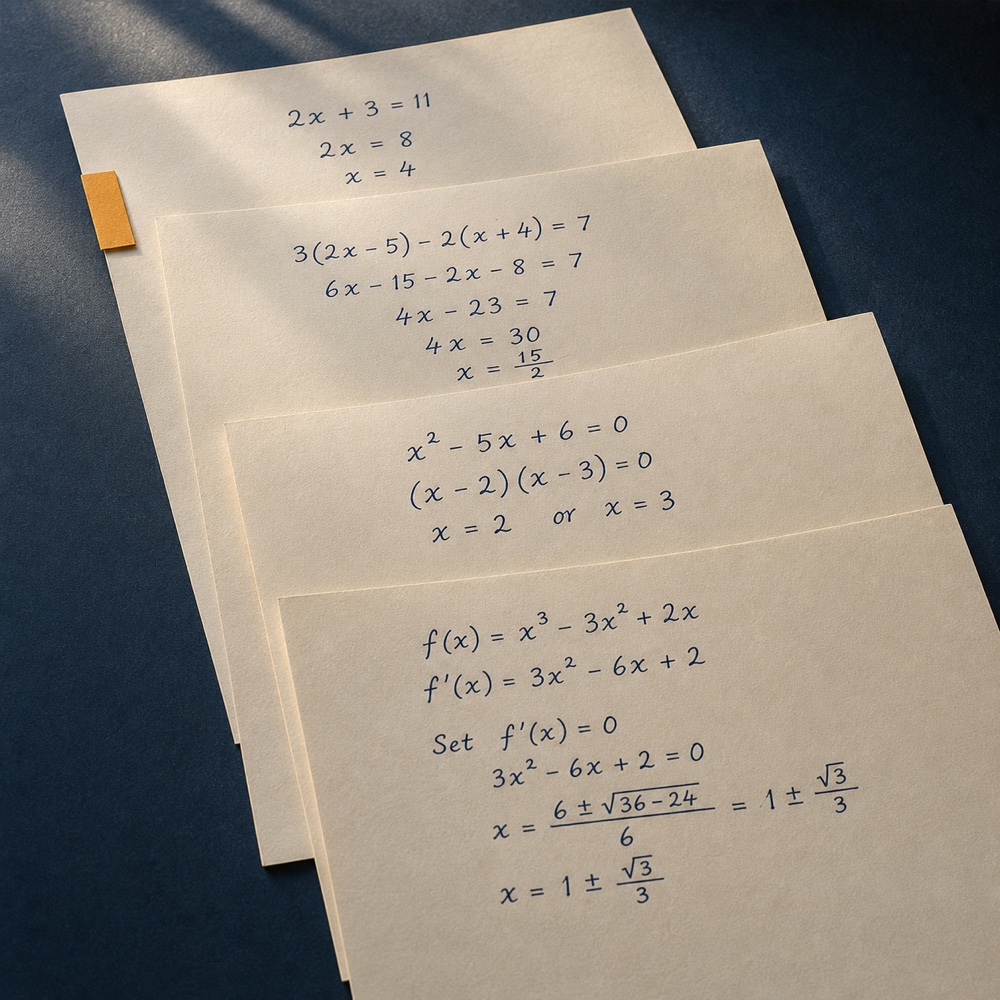
Spot weak Maths foundation before exam year visual
The window is Year 7 to Year 9. The cost goes up later.
Sign 1

The same kind of mistake keeps coming back

If the student keeps making sign errors, fraction mistakes, or rearranging slips across different chapters, the issue is not the chapter. It is the underlying method.

  • Same algebra slip in different topics.
  • Same kind of fraction error in number and geometry.
  • Same misread of a word problem in different contexts.
Sign 2

The student avoids questions with letters

Avoidance is a strong early signal. A student who skips algebra questions, or who only attempts the arithmetic part of a mixed question, is usually compensating for weak algebra confidence.

  • Leaving algebra questions blank under time pressure.
  • Always asking the parent before starting an algebra question.
  • Saying "I do not know how to start" before reading the question.
Sign 3

Mental shortcuts replace written working

A student with weak foundations often does multiple steps in the head to avoid writing them down. It works on small numbers and breaks on bigger ones.

  • One-line answers to multi-step questions.
  • Working that does not match the final answer.
  • Cannot explain how they got from one line to the next.
Sign 4

Needs prompting to start

Confidence to begin a question is a foundation skill. A student who needs to be told the first step every time has not yet built that confidence.

  • Waits for an example before attempting.
  • Copies steps without knowing why they work.
  • Cannot attempt a slightly changed version of a familiar question.
A simple parent check

Five minutes that reveal a lot

Ask "why"

Pick one homework question. Ask the student to explain why each line works, not just what they wrote. Hesitation reveals where the method is shallow.

Re-attempt cold

Take a question they got right last week. Ask them to redo it from scratch today, with the original answer covered. If they cannot, the method was not retained.

Change one number

Take a familiar question and change one value. If the student freezes, they may be matching patterns rather than understanding the method.

When to act

Why early years matter more than they feel

Year 7, Year 8, and Year 9 feel like there is plenty of time. There is, but only if it is used. Weak foundations from these years quietly stack up and become the reason Year 10 and Year 11 students lose IGCSE marks they "should" have earned. The earlier the weak step is named, the less the student has to unlearn later.

What MathPert checks

A short diagnostic, not a panic

Teacher Au looks at number fluency, fraction confidence, algebra language, and written layout, then decides whether the issue is knowledge, method, or habit. The aim is to give parents a specific weak step, not a general "needs more practice".

Related reading

Related parent guides

Weak Maths foundations

The deeper symptom view: what weak foundations actually look like at home.

Read more

Hidden gaps guide

A HowTo on noticing repeated weak Maths steps before IGCSE.

Read the guide
Questions parents ask

Common questions

Year 7 to Year 9 is the best window. The early signs are usually visible before IGCSE pressure begins.

WhatsApp MathPert