
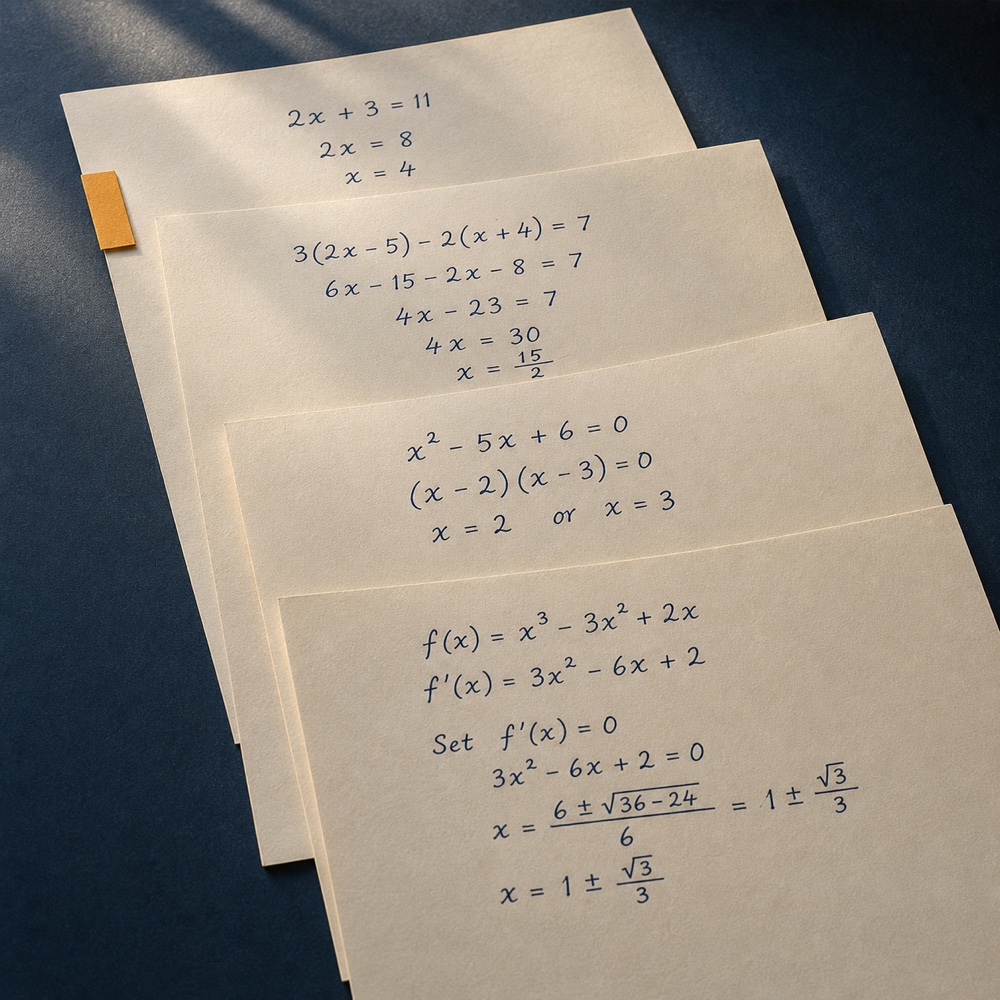
Parent guide

How to spot hidden Maths foundation gaps

Hidden Maths gaps usually stay hidden until the questions get longer, less guided, or more symbolic. This guide helps parents notice the pattern before that moment arrives.

Cutaway visual showing hidden structural gaps
A clean surface can hide a weak internal layer.
Parent guide

Passing does not always mean the foundation is secure

A student can get through schoolwork when each question is short, familiar, and has guidance built in. The foundation problem appears when the student has to connect steps independently, with no example in front of them and no teacher to prompt the next move.

What to look for

  • The same type of mistake returns even after reminders and extra practice sessions.
  • The student cannot explain why a step works, only that it does.
  • They can complete a question right after seeing the example, but the same question a week later looks unfamiliar.
  • Longer, multi-step questions fall apart because one of the earlier steps is not automatic enough to carry into the next.

What to do next

  • Do not start by adding more worksheets. More repetition of a broken step just makes the broken habit faster.
  • Name the weak step as specifically as possible: fractions, sign errors in algebra, question reading, layout.
  • Use the diagnostic if you are not sure whether the issue is foundation, algebra control, or exam method.
  • Then match the concern to the year-level page that fits where your child is now.

Where hidden gaps usually sit, by stage

Foundation gaps rarely announce themselves. They sit quietly below topics the student appears to manage, and each year has its usual hiding places.

  • Year 7 and Year 8: fractions and decimals, negative numbers, and order of operations. Tests at this stage are short and guided, so a student can pass them while still hesitating on these basics. See the Year 7 and Year 8 stage pages for what a secure foundation looks like at each level.
  • Year 9: algebra rearranging, substitution, ratio, and the first properly abstract work. This is where earlier number weakness starts to cost more, because algebra assumes number work is already automatic. The Year 9 pre-IGCSE page explains why catching gaps here matters more than it might feel like.
  • Year 10 and Year 11: multi-step IGCSE questions, worded problems, timed papers. The issue here is rarely a missing topic. It is usually a step that was never fully automatic, which collapses under pressure the moment three or four steps have to connect in a single question.

Why more practice rarely closes a hidden gap

The most common parent response to slipping marks is more worksheets. It feels productive. But if the weak step is still broken, every extra question rehearses it. The student gets faster at doing it wrong, and more confident in the wrong habit, which makes the gap harder to find and harder to undo later.

Practice works when it follows a correct method. It does not create one. That is why a student can do fifty questions and gain two marks, while another student fixes one weak step and jumps a grade. If this pattern sounds familiar, read why more practice is not improving the marks.

How MathPert reads a weak step

In class, Teacher Au works through four checks rather than re-teaching a whole topic:

  • Spot: find the exact line in the working where the method breaks. Not the topic name. The step.
  • Diagnose: decide whether the break is a foundation issue, an algebra control issue, or an exam-method issue. Each needs a different fix, and guessing wrong wastes the time.
  • Decide: fix the smallest thing first. Rebuilding one step is faster than re-teaching a chapter. The student also feels the win immediately, which matters.
  • Verify: return to a similar question days later, without prompting. If the method holds, the step is secure. If the same mistake reappears, the fix has not landed yet and needs another pass.

This is the core of the MathPert teaching method, and it is why the class is kept small. The working has to be seen for the weak step to be found. In a large class, the teacher never sees the line where it breaks. If the exam year is approaching, the guide on spotting a weak foundation before exam year covers the timing question directly.

A simple check parents can do this week

You do not need to mark maths to spot a gap. Take one returned test or homework, pick one wrong question, and ask your child to redo it out loud. Listen for three things:

  • "That is just the rule" with no reason behind it. The step is memorised, not understood. It will fail the moment the question is rephrased.
  • A long pause at the same kind of step each time. That pause is usually the weak step itself.
  • A correct answer the second time with no idea what changed. The method is not stable. It worked by luck or by re-reading the original example.

Any one of these is worth checking properly. The free diagnostic does that in a structured way. Or send a photo of the working to MathPert on WhatsApp and ask where it breaks. Teacher Au replies personally, usually the same day.

Questions parents ask

Common questions

Guided examples and short exercises do not expose weak steps. The student gets enough scaffolding to reach the answer, so the gap stays hidden. It only shows up when the question is longer, less familiar, or has a step missing from the example they learned from.

WhatsApp MathPert