Parent guide

Common careless mistakes in IGCSE Maths

Most "careless" mistakes in Cambridge IGCSE Maths 0580 are not random. They follow a pattern, which means they can be named and fixed.

Short answer

If a mistake repeats, it is not carelessness. It is a habit.

Telling a student to "be more careful" rarely changes anything. What changes things is naming the exact pattern: a sign error when moving terms, a missed unit, a misread word, a graph axis misread, or a rushed final-step calculation. Once a pattern has a name, the student can watch for it instead of being surprised by it.

This guide lists the careless mistake patterns we see most often in IGCSE Maths 0580, so parents can recognise them and ask the right follow-up question instead of a frustrated one.

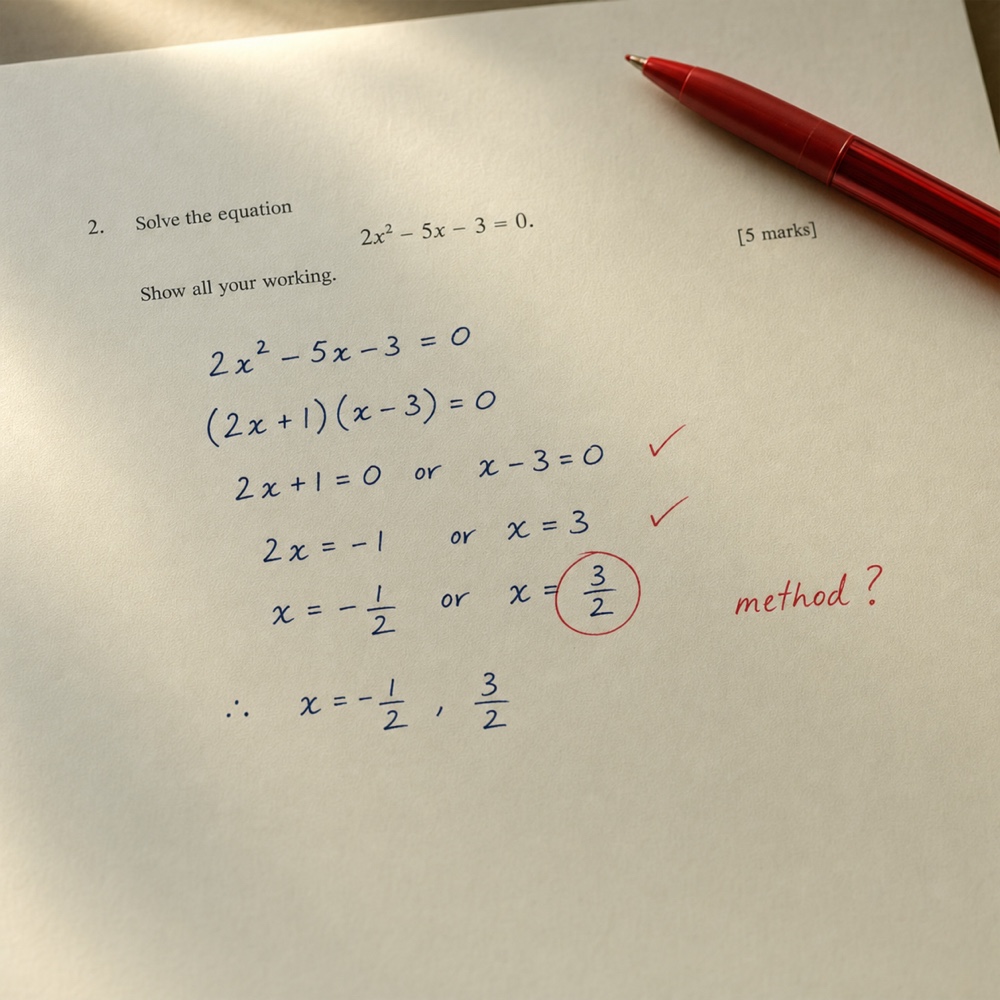
IGCSE Maths exam method and careless mistake visual
Patterns can be named. Once named, they can be fixed.
Pattern 1

Sign errors when rearranging

Moving a term across the equals sign without flipping the sign is one of the most common lost-mark causes. It also happens when expanding brackets with a minus outside.

  • Forgetting the negative when subtracting a bracket.
  • Losing the sign in long fraction rearrangements.
  • Mixing up plus and minus in trigonometric identities.
Pattern 2

Misreading the question

Many marks are lost in the first ten seconds, before any working starts. The student answers a slightly different question from the one printed.

  • Solving for x when the question asks for y.
  • Missing units (cm vs. m, degrees vs. radians).
  • Skipping the words "leave your answer in surd form" or "to 3 significant figures".
Pattern 3

Calculator slips on the final step

After several lines of correct working, the student types the wrong key and writes down a final answer that does not match their own working.

  • Forgetting brackets around a numerator or denominator.
  • Pressing degrees mode when the question is in radians (or vice versa for Add Maths).
  • Rounding too early and losing accuracy marks.
Pattern 4

Skipping written working

In Cambridge 0580, method marks are awarded for working shown. A correct final answer with no working can still lose marks if the question expects working.

  • Doing several steps in the head instead of on paper.
  • Crossing out working that turned out to be correct.
  • Writing the answer in the margin without the line that produced it.
Pattern 5

Geometry and diagram reading

Diagram questions are often where careless marks pile up: misreading an angle, assuming a shape is to scale, or missing a parallel-line marker.

  • Assuming a triangle is right-angled when it is not labelled as one.
  • Missing tick marks that indicate equal sides.
  • Reading a bearing in the wrong direction.
Pattern 6

Graph and table misreads

Statistics and graph questions reward careful reading. A careless misread on the axis often costs more marks than a hard algebra question.

  • Reading the wrong axis scale (1 box = 2 units, not 1).
  • Misreading a frequency table column.
  • Confusing median and mean under time pressure.
What helps

Three habits that reduce careless mistakes

Write every line

The student writes one step per line, not three steps merged. This alone catches most sign and bracket slips.

Re-read before answering

Before circling the final answer, the student re-reads the question to check what was actually asked and in what units or form.

Keep a mistake log

A short list of recurring mistake patterns, reviewed weekly. It turns vague carelessness into a specific watchlist.

Related reading

Related parent guides

Why students lose marks in Add Maths

The same patterns become more costly in Cambridge 0606. A parent guide on what to fix first.

Read the guide

Weak in algebra

Many "careless" mistakes are actually unstable algebra. This is the deeper layer.

Read more

Cannot do exam questions

When the student understands class but cannot finish exam questions, the problem is usually method transfer.

Read more
Questions parents ask

Common questions

Often no. Most so-called careless mistakes follow a pattern, which means they are method or habit issues rather than random slips.

WhatsApp MathPert