
Parent guide

How to prepare for IGCSE Maths in 5 months

A realistic five-month plan for Cambridge IGCSE Maths 0580. The aim is to fix the highest-mark weak areas first, not to grind through every chapter again.

Short answer

Five months is enough if the time is targeted, not just filled.

Most Cambridge 0580 students can make real progress in five months. The common mistake is spreading all five months across broad revision. A sharper plan: one month to diagnose, one month to repair the weakest areas, then three months of structured past-paper work with exam habits built in. That protects the highest-mark topics instead of wasting time on areas that are already solid.

The plan below assumes the student attends school and has roughly one tuition class plus three to five hours of independent practice per week. It can be compressed or stretched depending on where the student starts.
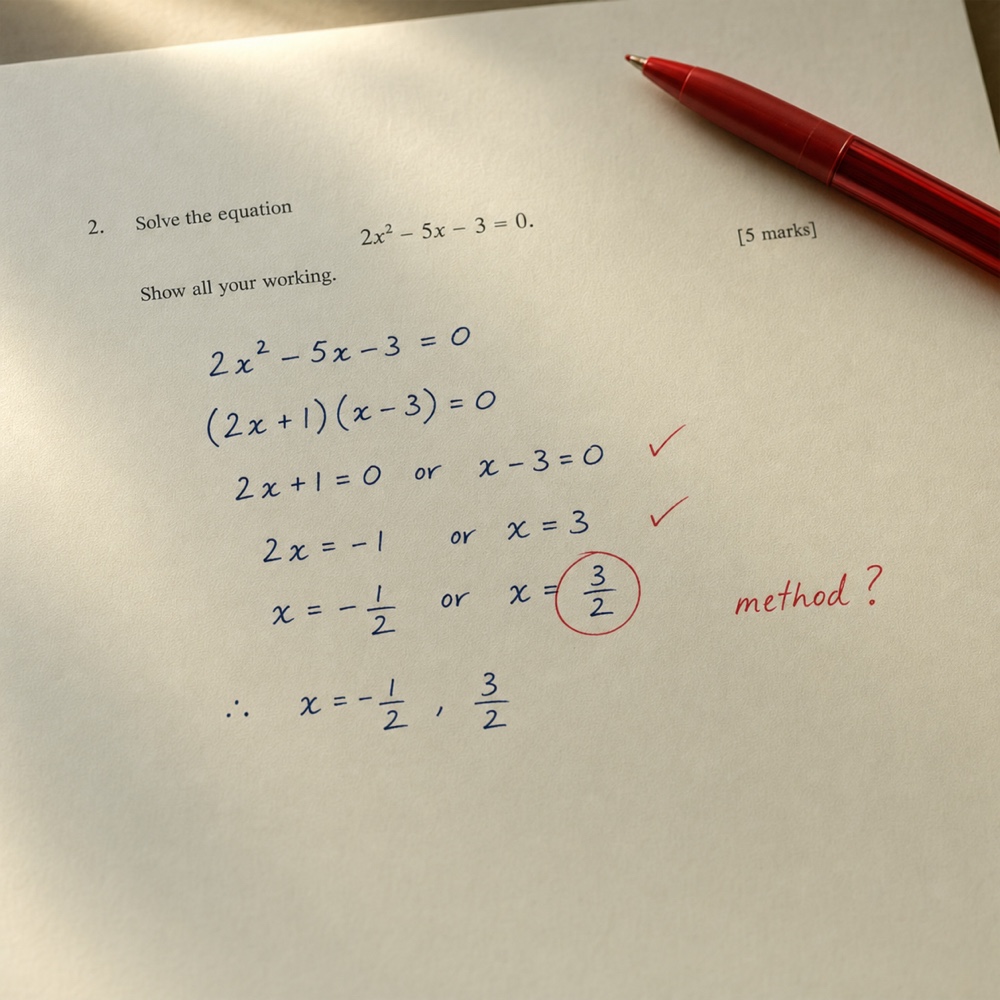
IGCSE Maths 5-month preparation plan visual
Targeted time beats broad time.
Month 1

Diagnose the weak step

Sit one full past paper under timed conditions and mark it honestly. Sort every lost mark into a category: algebra, geometry, statistics, exam method, or a habit like rushing or skipping working.

  • Pick the two largest mark-loss categories.
  • Ignore minor topics for now.
  • Decide whether the issue is knowledge, method, or habit.
Month 2

Repair foundations

Spend month two on the two weakest areas only. Not the whole syllabus. Understand the method, write it out step by step, then practise until the steps feel automatic.

  • If algebra is weak, repair before any past paper work.
  • If exam method is weak, drill question-reading and layout.
  • If a single topic is weak, isolate it before mixing back in.
Month 3

Topic past papers

Switch to past-paper questions sorted by topic, not full papers yet. The aim is to build the method in real exam wording. Time pressure comes later. Right now, an error should tell you something about the method, not just "I rushed."

  • Pick five questions per topic, mark immediately, re-attempt wrong ones.
  • Keep a one-line note for each mistake pattern.
  • Use Cambridge mark schemes to see where method marks live.
Month 4

Full papers under time

Two full past papers a week, sat under timed conditions, marked the next day. This builds stamina and shows clearly where the gap is between practise performance and exam performance.

  • Always review the marked paper, do not just look at the score.
  • Re-do any question that lost more than two marks.
  • Watch for the same mistake pattern returning.
Month 5

Tight revision and exam method

The final month is about keeping the marks the student has already earned. Stop loading new topics. The time is too short for that. Sharpen habits instead.

  • Reading the question slowly before starting.
  • Writing every line of working, even when the answer feels obvious.
  • Checking units, significant figures, and final-answer format.
What to drop

Things that waste the five months

  • Re-doing topics the student already handles well.
  • Random worksheets without a feedback loop.
  • Watching videos passively without then attempting questions.
  • Last-minute new-topic learning in the final two weeks.
What MathPert provides

Where this plan connects to support

Diagnostic

A structured first check so the five-month plan starts from the actual weak spot, not a guess.

Start the diagnostic

IGCSE Maths tuition

Weekly small-group class with Teacher Au, focused on method and structured working.

See IGCSE Maths

Revision map

A topic-by-topic view that helps decide what to attack first inside the five months.

Open the revision map
Questions parents ask

Common questions

For most students with reasonable foundations, yes. Students with deep gaps may need more time on basics before past papers.

WhatsApp MathPert